












My Distracted Child: First Grade Matters
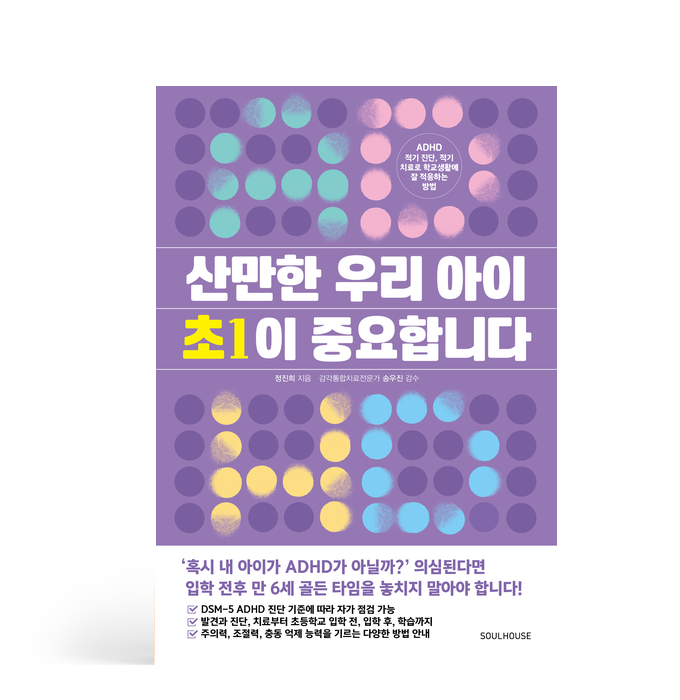
*You can see it as a big image when you click it.
How timely ADHD diagnosis and treatment help your child adjust to school
My Distracted Child: First Grade Matters
| Author | Jeong, Jinhee (Reviewed by Song, Woojin) |
|---|---|
| Publisher | SOULHOUSE |
| Publish Date | 2024/12/23 |
| Price | 19,800 Won |
| Size/Pages | W 152mm, H 210mm, Thickness 19mm, 328 pages |
| ISBN | 979-11-88915-78-1 |
| Category | Parenting |
| Keywords | #ADHDSchoolReadiness, #EarlyADHDDiagnosis, #ADHDHomeTherapy, #ADHDLearning |
Don’t be fooled by hyperfocus or tactless sociability that mislead parents.
If your distracted child says, “Mom, I don’t want to, but it just comes out,” it is time to stop avoiding it and help with the struggle.
A mother whose child was diagnosed with ADHD right before school, together with a sensory integration therapist,
shows many ways to build attention, self-regulation and impulse control.
Overview
If your child is so absorbed in building LEGO that he refuses to come to the table for hours, is that good concentration or hyperfocus? Excessive absorption in a single activity, or overly cheerful behavior that ignores other people’s feelings, can be a sign of ADHD. If parents mistake these signs for no problem at all, they can miss the critical window for diagnosis and treatment.
According to the Korean Academy of Child and Adolescent Psychiatry, ADHD affects 5.9 to 8.5% of children, yet only 0.8% are diagnosed at a hospital. Without timely diagnosis and treatment, the risk of secondary problems such as tics, depression, anxiety and learning disorders rises in adolescence, and about 57% of childhood ADHD continues into adulthood. Age six, around the start of elementary school, is the golden time for diagnosis and treatment.
This book was written by a mother who recognized her child’s ADHD just before elementary school and helped him through quick diagnosis and proper treatment. Drawn straight from real experience, it offers the empathy and know-how only a mother raising a child with ADHD can give. Together with Dr. Song Woojin, a sensory integration therapist who has treated the social skills of children with ADHD, it presents concrete ways to build attention, self-regulation and impulse control at home.
Part 1 covers the signs, diagnosis and treatment of ADHD; Part 2 covers adjusting to school, from school supplies and daily routines to friendships and learning attitudes; and Part 3 presents seven skills parents can practice at home: conversation, expression, discipline, praise, rewards, social skills and habits. It will be a dependable companion for both parents and children on the way to a better school life and a happier future.
About the Author - Jeong, Jinhee
A working mother who spent ten years analyzing more than a thousand companies a year and planning recruitment and training. Right after she left her job, her child was diagnosed with ADHD, and she devoted herself to his treatment, reading books and papers on ADHD and visiting hospitals and centers. Going through first grade, she realized how important it is not to miss the right time for treatment, and wrote this book for parents walking the same path. She runs the Instagram account “ADHD School” and the blog “Lamp Genie.”
Reviewed by Song, Woojin — Majored in occupational therapy at the Graduate School of Yonsei University and earned a doctorate in public health from CHA University. Provided pediatric occupational therapy and sensory integration therapy at Bundang CHA Hospital, conducted rehabilitation research at Samsung Medical Center, and taught as a visiting professor of occupational therapy at Dongseo University. A certified Clinical Psychologist Level 2, currently provides parent education, sensory integration therapy, occupational therapy and group social-skills therapy at a child development center.
Features
● Self-check based on the DSM-5 diagnostic criteria for ADHD.
● Behavioral traits and early clues of ADHD, including behaviors parents easily misread.
● Guidance on various treatments, including medication, exercise therapy and sensory integration therapy.
● Detailed guide to adjusting to elementary school, from school supplies and eye exams to getting to school, school lunch and friendships.
● Ways to build learning attitudes such as attention and self-regulation.
● Seven skills for helping your child: conversation, expression, discipline, praise, rewards, social skills and habits.
● Includes 30 picture books to read together before school and 30 days of encouraging pencil-case messages.
Table of Contents
Recommendation – Walk Together and Wait Until the Tipping Point from a Distracted Brain to a Focused Brain
Preface – It’s Okay, We’re Almost There
Part 1. Is My Distracted Child ADHD?
Discovery
Diagnosis
Treatment
Part 2. How Does My Distracted Child Adjust to School?
Before School
After Starting School
Learning
Part 3. Ways to Help My Special Child
Seven Skills to Practice at Home
1. Conversation – The First Step to Effective Communication
2. Expression – Naturally Drawing Out Self-Expression
3. Discipline – Calmly Managing Hyperactivity
4. Praise – Reinforcing Positive Behavior
5. Rewards – Real Rewards That Raise Motivation
6. Social Skills – Maintaining Good Relationships
7. Habits – Time to Build New Habits
Closing – Family Understanding Helps a Child Grow
Appendix: 30 Days of Picture Books That Grow the Heart and Mind
Appendix: Positive Affirmations for Children, 30 Days of Pencil-Case Messages